About the Journal

   Journal title  : Innovapedia: Journal of Multidisciplinary Knowledge and Civilization
   Initials  : innovapedia
   Abbreviation  : innovapedia J. Multidiscip. Res. Innov.
   Frequency  : January, April, July, October
   DOI  : https://doi.org/10.55681/aspirasidigital by Crossref
   Online ISSN  : xxxx-xxxx
   Editor-in-Chief  : Ahmad Hadi Pranoto, S.Pd.,M.Pd.
   Publisher  : LPPM Institut Pendidikan Nusantara Global
   Citation Analysis  : [Sinta] [Google Scholar]

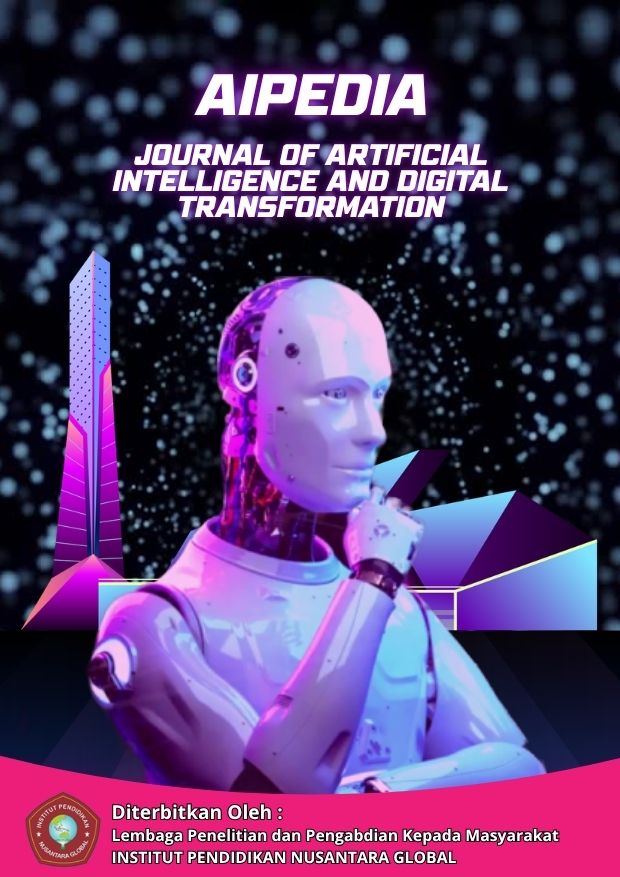
AIPedia: Journal of Artificial Intelligence and Digital Transformation is a peer-reviewed, open-access international journal dedicated to publishing pioneering research at the vanguard of computational intelligence, algorithmic architectures, and systemic digital evolution. Positioned at the intersection of computer science, data engineering, and socio-technical studies, the journal serves as an authoritative scholarly forum for artificial intelligence researchers, data scientists, software engineers, and digital transformation specialists worldwide. AIPedia prioritizes macro-level conceptualizations, rigorous algorithmic validations, and critical empirical investigations that examine the disruptive mechanisms of intelligent systems. By bridging complex neural computational models with macro-level socio-economic disruptions, the journal fosters a deep, comprehensive understanding of how automated intelligence reconfigures institutional governance, industrial value chains, and human-computer interactions.

Scope and Topics

The journal welcomes high-quality original research articles, critical reviews, and conceptual papers that offer significant contributions to the following thematic areas:

  • Artificial Intelligence & Machine Learning Paradigms: Deep learning architectures, reinforcement learning, computer vision, natural language processing (NLP), generative AI models, and explainable AI (XAI).

  • Data Engineering & Intelligent Ecosystems: Big data analytics, cloud, fog, and edge computing integration, cognitive computing, knowledge graph engineering, and advanced semantic networks.

  • Digital Transformation Frameworks & Industrial IoT: Smart manufacturing, automation, cyber-physical systems, robotic process automation (RPA), digital twin technology, and corporate technology adoption dynamics.

  • Autonomous Systems & Smart Infrastructure: Robotics, autonomous vehicles, smart grid management, urban computing, algorithmic optimization in logistics, and smart city architectures.

  • AI Ethics, Governance & Socio-Technical Impacts: Algorithmic bias, data privacy frameworks, regulatory policies for automated systems, AI compliance, and the future of work within automated societies.

Publication Frequency

To ensure rigorous editorial oversight, thorough peer review, and timely dissemination of cutting-edge algorithmic discoveries, AIPedia is published semi-annually (2 issues per year, typically scheduled for release in June and December). Special thematic issues focusing on paradigm shifts in generative technologies, emergent cyberthreats, or groundbreaking industrial transformations may be commissioned by the Editorial Board.

Peer Review Process

AIPedia enforces a strict double-blind peer review policy to maintain the highest standards of technical validity and academic integrity.

  1. Initial Desk Evaluation: Every submission undergoes a preliminary screening by the Editor-in-Chief or a relevant Technical Editor to evaluate thematic alignment, methodological soundess, and structural integrity. Plagiarism screening via Turnitin/iThenticate is strictly executed at this stage, requiring a similarity index below the journal's maximum threshold.

  2. Expert Peer Review: Manuscripts passing the desk evaluation are anonymized and assigned to at least two independent international reviewers who are established experts in the specific domain of artificial intelligence or computational engineering.

  3. Editorial Decision: Based on the reviewers' recommendations, the Editorial Board renders one of four decisions: Acceptance, Revisions Required (Minor/Major), Resubmit for Review, or Rejection. The final decision rests entirely on the intellectual merit, mathematical rigor, and transformative potential of the work.


Mission Statement: "The mission of AIPedia is to deconstruct computational complexities and catalyze ethical technological acceleration within an increasingly automated global society. Grounded in the philosophy that artificial intelligence should act as a transparent, secure, and human-centric instrument for global progress, the journal aims to democratize advanced computational knowledge by providing an unrestricted, high-impact platform for global scholarly dialogue. Through the promotion of diverse and robust methodological approaches—encompassing empirical software validation, mathematical theorem proving, and quantitative case studies—AIPedia seeks to empower technology architects, inspire corporate innovators, and shape future-proof regulatory policies for global digital governance."