
∴ MENUS ∴
∴ SUBMISSION ∴
∴ JOURNAL TEMPLATE ∴
 |
 |
∴ INFORMATION ∴
∴ ISSN BARCODE ∴
 |
∴ INDEXING ∴
 |
 |
 |
 |
∴ TOOLS ∴
 |
 |
 |
 |
∴ STATISTIC ∴
∴ MEMBER ∴
 |
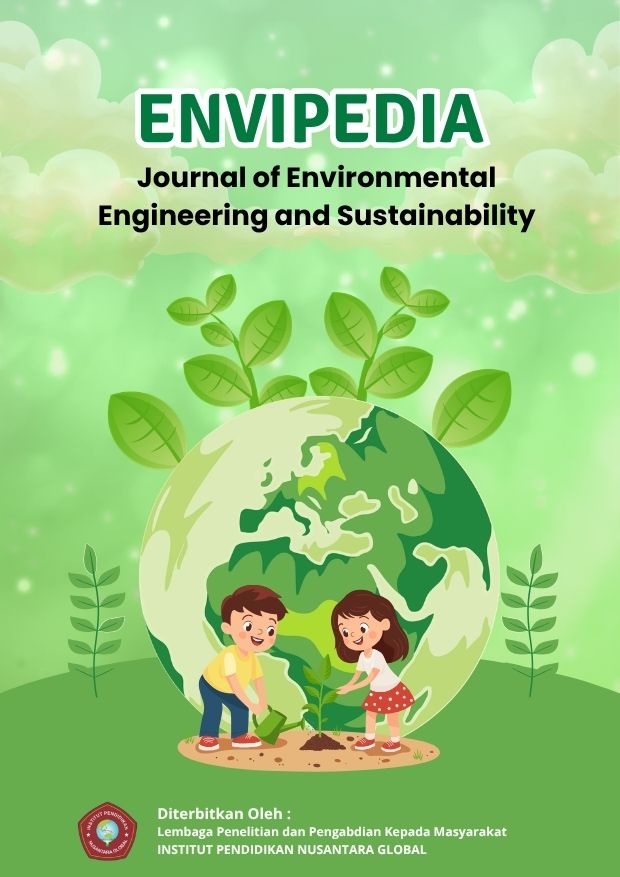
EnviPedia: Journal of Environmental Engineering and Sustainability
Frequency: 4 issues per year
About the Journal
|
 |
EnviPedia: Journal of Environmental Engineering and Sustainability is a peer-reviewed, open-access international journal dedicated to publishing pioneering research at the forefront of environmental technologies, ecological engineering, and sustainable development. Positioned at the critical intersection of applied sciences, infrastructure engineering, and environmental policy, the journal serves as an authoritative scholarly forum for environmental engineers, ecologists, urban planners, and sustainability policy analysts worldwide. EnviPedia prioritizes macro-level systemic frameworks, rigorous experimental and computational designs, and innovative technological solutions that mitigate anthropogenic impacts on global ecosystems. By bridging raw laboratory engineering breakthroughs with scalable circular economy workflows, the journal fosters a holistic understanding of resource optimization, pollution control, and climate resilience in a changing global landscape.
The journal welcomes high-quality original research articles, critical reviews, and conceptual papers that offer significant contributions to the following thematic areas:
Water & Wastewater Engineering: Advanced water purification, industrial wastewater treatment metrics, membrane technologies, decentralized sanitation systems, and water resource management.
Air Pollution Control & Climate Engineering: Emission control technologies, carbon capture, utilization, and storage (CCUS) frameworks, ambient air quality modeling, and atmospheric monitoring systems.
Solid & Hazardous Waste Management: Circular waste-to-energy architectures, e-waste recycling protocols, bioremediation, landfill engineering, and lifecycle analysis of hazardous contaminants.
Renewable Energy Systems & Eco-Efficiency: Green energy integration, bio-resource optimization, clean manufacturing designs, energy-efficient building frameworks, and carbon footprint reduction strategies.
Socio-Ecological Resilience & Environmental Policy: Environmental impact assessments (EIA), climate change adaptation frameworks, political ecology, sustainable urban-rural planning, and global environmental governance metrics.
To ensure rigorous editorial oversight, thorough peer review, and timely dissemination of critical environmental discoveries, EnviPedia is published semi-annually (2 issues per year, typically scheduled for release in June and December). Special thematic issues focusing on urgent ecological crises, net-zero carbon milestones, or emerging clean tech disruptions may be commissioned by the Editorial Board.
EnviPedia enforces a strict double-blind peer review policy to maintain the highest standards of scientific validity and environmental integrity.
Initial Desk Evaluation: Every submission undergoes a preliminary screening by the Editor-in-Chief or a relevant Technical Editor to assess thematic alignment, methodological soundess, and structural compliance. Plagiarism screening via Turnitin/iTesticate is strictly executed at this stage, requiring a similarity index below the journal's maximum threshold.
Expert Peer Review: Manuscripts passing the desk evaluation are anonymized and assigned to at least two independent international reviewers who are established experts in the specific domain of environmental engineering or planetary sustainability.
Editorial Decision: Based on the reviewers' recommendations, the Editorial Board renders one of four decisions: Acceptance, Revisions Required (Minor/Major), Resubmit for Review, or Rejection. The final decision rests entirely on the empirical merit, reproducibility of engineering data, and transformative potential of the work.
The mission of EnviPedia is to deconstruct industrial and ecological complexities, catalyzing clean and resilient engineering pathways within a rapidly changing planetary ecosystem. Grounded in the philosophy that cutting-edge technology and strict ecological preservation are the ultimate anchors for human health, industrial longevity, and global equity, the journal aims to democratize advanced environmental knowledge by providing an unrestricted, high-impact platform for global scholarly dialogue. Through the promotion of diverse and robust methodological approaches—encompassing empirical pilot-scale validation, predictive mathematical modeling, and longitudinal quantitative sustainability analyses—EnviPedia seeks to empower technology architects, inspire environmental developers, and shape future-proof, evidence-based green policies worldwide.
EnviPedia: Journal of Environmental Engineering and Sustainability is indexed and/or available catalogue in:










∴ MENUS ∴
∴ SUBMISSION ∴
∴ JOURNAL TEMPLATE ∴
|
|
∴ INFORMATION ∴
∴ ISSN BARCODE ∴
|
∴ INDEXING ∴
|
|
|
|
∴ TOOLS ∴
|
|
|
|
∴ STATISTIC ∴
∴ MEMBER ∴
|
EnviPedia: Journal of Environmental Engineering and Sustainability
Frequency: 4 issues per year
