∴ MENUS ∴
∴ SUBMISSION ∴
∴ JOURNAL TEMPLATE ∴
 |
 |
∴ INFORMATION ∴
∴ ISSN BARCODE ∴
 |
∴ INDEXING ∴
 |
 |
 |
 |
∴ TOOLS ∴
 |
 |
 |
 |
∴ STATISTIC ∴
∴ MEMBER ∴
 |
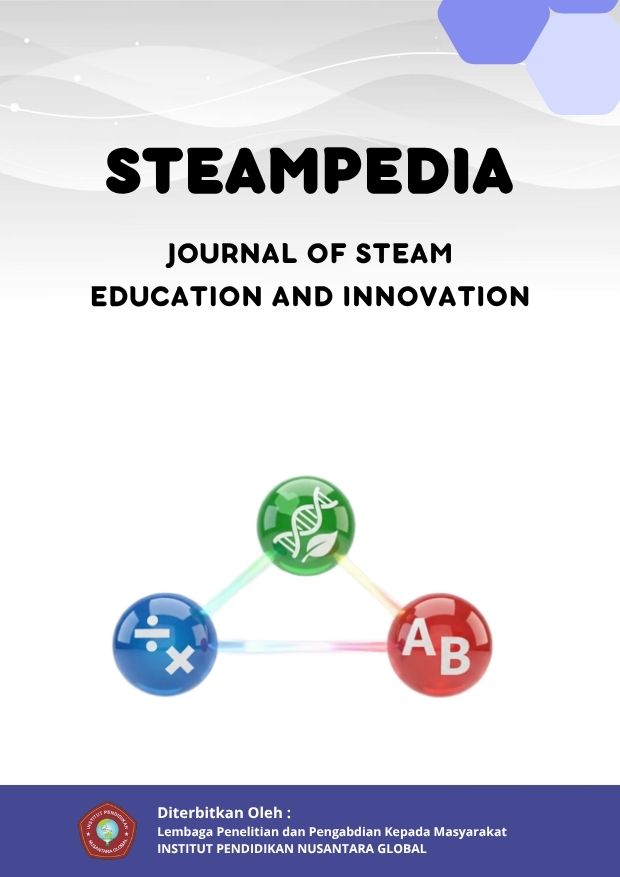
SteamPedia: Journal of STEAM Education and Innovation
Frequency: 4 issues per year
 |
Journal title | : | SteamPedia: Journal of STEAM Education and Innovation | |
| Initials | : | Steampedia | ||
| Abbreviation | : | SteamPedia J. STEAM Educ. Innov. | ||
| Frequency | : | January, April, July, October | ||
| DOI | : | https://doi.org/10.55681/aspirasidigital by Crossref | ||
| Online ISSN | : | xxxx-xxxx | ||
| Editor-in-Chief | : | Ahmad Hadi Pranoto, S.Pd.,M.Pd. | ||
| Publisher | : | LPPM Institut Pendidikan Nusantara Global | ||
| Citation Analysis | : | [Sinta] [Google Scholar] |
SteamPedia: Journal of STEAM Education and Innovation is a peer-reviewed, open-access international journal dedicated to pioneering research at the vanguard of integrated education frameworks encompassing Science, Technology, Engineering, Arts, and Mathematics (STEAM). Positioned at the critical intersection of transdisciplinary pedagogy, cognitive development, and technological disruption, the journal serves as an authoritative scholarly forum for educational researchers, curriculum design architects, creative technologists, and instructional psychologists worldwide. SteamPedia prioritizes macro-level systemic evaluations, rigorous empirical action research, and disruptive educational paradigms that address the complexities of modern student-centered learning. By bridging technical empirical sciences with artistic and humanistic design thinking, the journal fosters a holistic understanding of how transdisciplinary models develop creativity, critical problem-solving skills, and socio-technical adaptation in a rapidly shifting global workforce.
The journal welcomes high-quality original research articles, critical reviews, and conceptual papers that offer significant contributions to the following thematic areas:
STEAM Transdisciplinary Frameworks: Epistemological approaches to integrating Arts into STEM, cross-curricular mapping methodologies, and the structural design of collaborative learning models.
Pedagogical Innovations & Instructional Design: Project-based learning (PBL), inquiry-based education, computational thinking, educational gamification, and maker-spaces in formal and informal educational settings.
Creativity, Arts, and Technological Synthesis: Digital media arts, creative coding, design thinking in engineering education, physical computing, and music-math integration frameworks.
Educational Policy, Curriculum & Assessment: Macro-level strategies for national STEAM integration, future-proof assessment metrics for multi-disciplinary skills, and continuous professional development for STEAM educators.
Inclusivity, Equity, and Diversity in STEAM: Mitigating gender and socio-economic disparities in technical disciplines, multicultural STEAM curricula, and democratic access to high-tech learning infrastructures.
To ensure rigorous editorial oversight, thorough peer review, and timely dissemination of cutting-edge educational discoveries, SteamPedia is published semi-annually (2 issues per year, typically scheduled for release in June and December). Special thematic issues targeting highly disruptive educational technologies, emergent pedagogical crises, or localized policy milestones may be commissioned by the Editorial Board.
SteamPedia enforces a strict double-blind peer review policy to maintain the highest standards of academic integrity and instructional validity.
Initial Desk Evaluation: Every submission undergoes a preliminary screening by the Editor-in-Chief or Managing Editor to assess multi-disciplinary alignment, methodological soundess, and structural compliance. Plagiarism screening via Turnitin/iThenticate is executed at this stage, requiring a similarity index below the journal's maximum threshold.
Expert Peer Review: Manuscripts passing the desk evaluation are anonymized and assigned to at least two independent international reviewers who are established experts in interdisciplinary education, pedagogical sciences, or specific creative-technical domains matching the submission.
Editorial Decision: Based on the reviewers' recommendations, the Editorial Board renders one of four decisions: Acceptance, Revisions Required (Minor/Major), Resubmit for Review, or Rejection. The final decision rests entirely on the intellectual merit, educational rigor, and empirical applicability of the work to the advancement of STEAM fields.
Mission Statement: "The mission of SteamPedia is to deconstruct academic insularity and catalyze innovative, holistic learning paradigms within an increasingly automated and complex global society. Grounded in the philosophy that the integration of logical sciences and creative arts is vital for cultivating human empathy, critical resistance, and sustainable industrial growth, the journal aims to democratize advanced pedagogical knowledge by providing an unrestricted, high-impact platform for global scholarly dialogue. Through the promotion of diverse and robust methodological approaches—ranging from quantitative longitudinal studies to qualitative case studies and action research—SteamPedia seeks to empower global educators, inspire curriculum innovators, and shape future-proof educational policies worldwide."
∴ MENUS ∴
∴ SUBMISSION ∴
∴ JOURNAL TEMPLATE ∴
|
|
∴ INFORMATION ∴
∴ ISSN BARCODE ∴
|
∴ INDEXING ∴
|
|
|
|
∴ TOOLS ∴
|
|
|
|
∴ STATISTIC ∴
∴ MEMBER ∴
|
SteamPedia: Journal of STEAM Education and Innovation
Frequency: 4 issues per year
